
How Personalized, Evidence-Based Care Improves High-Risk Pregnancy Outcomes

High-risk complications occur in 6% to 8% of pregnancies in the U.S. and require specialized treatment to ensure the best possible outcomes for both the pregnant patient and the fetus.
At the UCSF Center for Complex Obstetric Medicine, a multidisciplinary team cares for patients with high-risk pregnancies, pre-existing medical conditions or pregnancy complications. Roxanna Irani, MD, PhD, is a maternal-fetal medicine (MFM) specialist on the team. The executive medical director for Women’s Health at UCSF, she has published research on conditions affecting pregnancy, including preeclampsia, autoimmune diseases, cardiovascular disease and organ transplant, as well as fetal intervention options.
In this interview, she discusses collaborating with referring providers on patient care, managing complex conditions, fetal treatment and offering patients opportunities to participate in clinical trials.
How does the UCSF Health team partner with referring providers?
Community physicians can reach us 24/7, 365 days a year via a secure provider line. This is a direct way to contact a UCSF MFM at any time, whether that physician has a patient with an acute condition and wants to request a transfer or just has a question about care management – we’re happy to answer it.
By partnering with community physicians to increase patient safety, we’re able to create an interdisciplinary care plan that can be carried out at the local hospital or here at UCSF. It’s a joint decision with the referring provider, the UCSF MFM and the patient. We will always do what’s right for the patient.
So, we offer everything from one-time consultations to transfer for full prenatal care and delivery.
What kinds of complex conditions do you treat?
We take care of the highest risk patients using a multidisciplinary approach with team of highly skilled subspecialists that includes neurologists, endocrinologists, cardiologists, rheumatologists, hematologists, gastroenterologists, oncologists, infectious disease specialists and OB anesthesiologists. We also specialize in environmental exposures, preeclampsia, placenta accreta spectrum, recurrent pregnancy loss, substance use disorders, autoimmune conditions and sickle cell disease.
We’re ranked “high performing” for maternity care by U.S. News & World Report. This special recognition reflects the leadership, high standards, commitment and expertise of our clinical teams on a daily basis. We’re very proud of our staff and the obstetric care we deliver.
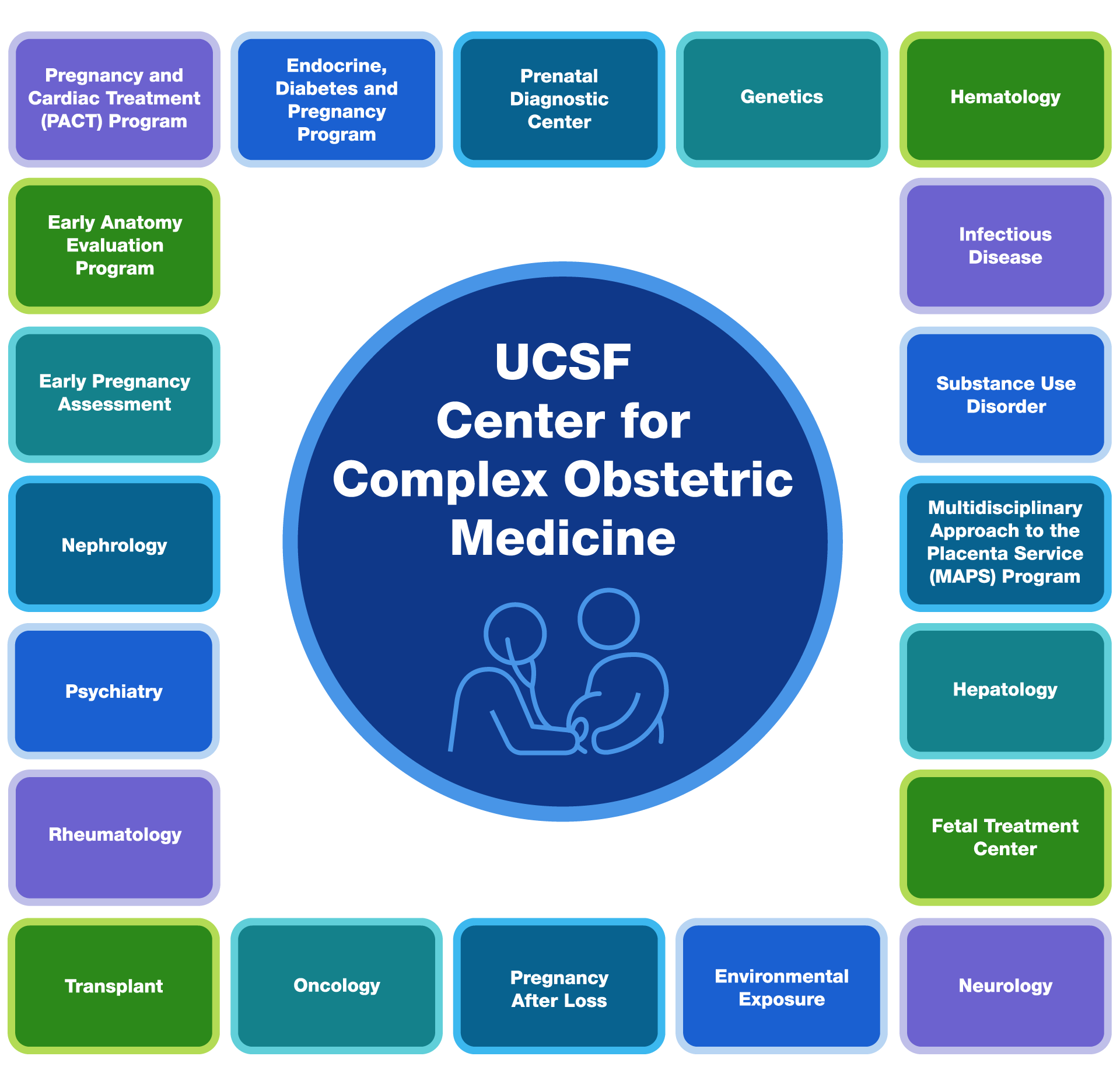
The UCSF Center for Complex Obstetric Medicine offers access to multidisciplinary programs, clinics and subspecialty care, including:
- The Pregnancy and Cardiac Treatment (PACT) Program
- The Endocrine, Diabetes and Pregnancy Program
- The Prenatal Diagnostic Center
- Genetics
- Hematology
- Infectious Disease
- Substance Use Disorder
- The Multidisciplinary Approach to the Placenta Service (MAPS) Program
- Hepatology
- The Fetal Treatment Center
- Neurology
- Environmental Exposure
- Pregnancy After Loss
- Oncology
- Transplant
- Rheumatology
- Psychiatry
- Nephrology
- Early Pregnancy Assessment
- The Early Anatomy Evaluation Program
What are the options for fetal treatment?
Our Fetal Treatment Center team has expertise in diagnosing and treating fetal abnormalities and genetic conditions. We have one of the largest genetic counseling groups in the country with specialists double-boarded in MFM and genetics. They offer testing and consultations for genetic disorders of the pregnant patient, their partner or the fetus, and can provide novel treatments during pregnancy.
UCSF is really on the cutting-edge of innovation and frontline, evidence-based care.
How do patients benefit from UCSF research and clinical trials?
Eligible patients have the option to join one of our many research programs, and we find they’re usually willing and excited to be part of them. The UCSF Department of Obstetrics, Gynecology and Reproductive Sciences consistently ranks No. 1 or No. 2 in the country for National Institutes of Health grant funding. Patient participation in research doesn’t change their clinical course of treatment, it only enhances their care.
There are many affiliate research groups like the California Preterm Birth Initiative and the UCSF Bixby Center for Global Reproductive Health. We’re also part of the Maternal Fetal Medicine Units Network, which involves us in large national and international randomized control trials. These are often landmark trials that set or change clinical practices across the nation and the world.
Is there a particularly complex case you can describe?
We treated a 36-year-old patient who was diagnosed with colon cancer during her pregnancy. She safely underwent chemotherapy while pregnant and after her healthy baby was born, the UCSF GI surgical oncology team successfully removed her tumors. Pregnancy may have saved her life because genetic screening tests led to the cancer detection.
To learn more
UCSF Center for Complex Obstetric Medicine
Phone: (415) 353-3400 | Fax: (415) 502-4616

